Cash-Out Refinance: When Tapping Equity Makes Sense
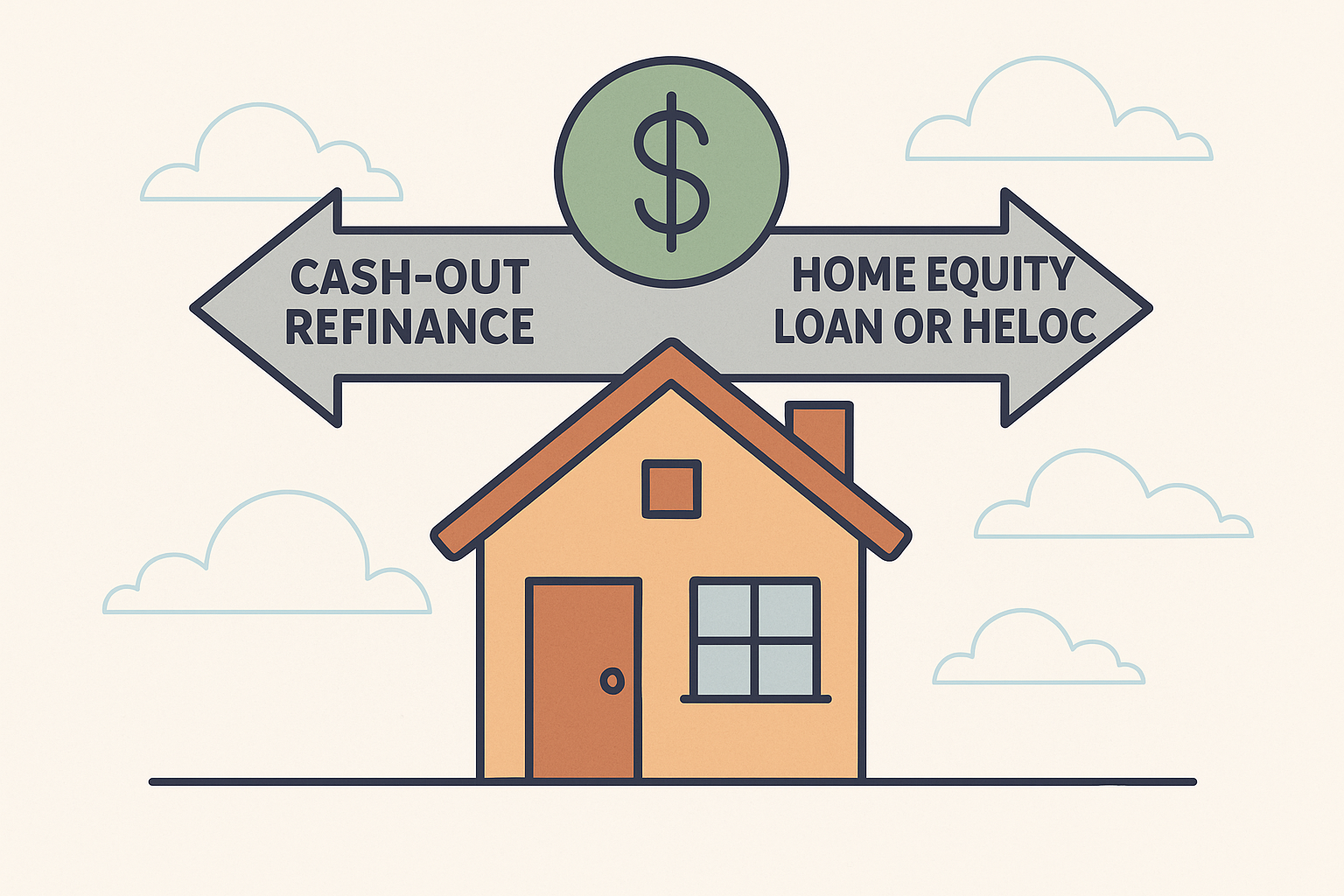
Turning home equity into cash can help cover major expenses, but the interest rate, closing costs and long-term impact on your mortgage matter.
We may earn a commission from offers on this site, but that never affects our editorial coverage. How we make money.
Key takeaways
- A cash-out refinance replaces your mortgage with a larger loan and pays you the difference — and the new rate applies to the whole balance, not just the cash.
- Many conventional cash-out refinances on a primary home cap the loan at 80% of the home’s value.
- Swapping a $250,000 loan at 3.50% for a $300,000 loan at 6.75% raises the payment by about $694 a month.
- If your current rate is low, compare a home equity loan or HELOC, which leave your first mortgage in place.
Your home may be worth significantly more than when you purchased it. And if you’ve been making mortgage payments for several years, you’ve probably built up equity along the way. That equity represents a valuable financial resource, but accessing it requires careful planning.
One option is a cash-out refinance, which allows homeowners to replace their existing mortgage with a larger loan and receive the difference in cash. The money can be used for home improvements, debt consolidation or other major expenses.
But there’s an important trade-off: borrowing against your home’s equity increases the amount you owe and may change your interest rate, monthly payment and repayment timeline. So when does a cash-out refinance actually make financial sense?
What is a cash-out refinance?
A cash-out refinance is a mortgage transaction that replaces your current home loan with a new, larger mortgage. The new loan pays off your existing mortgage balance, and you receive a portion of the difference in cash, after applicable transaction costs.
For example, imagine your home is worth $450,000 and you still owe $250,000 on your mortgage. That means you have approximately $200,000 in home equity. If you refinance into a new $300,000 mortgage, you could potentially receive $50,000 in cash before closing costs and other adjustments. Your original mortgage is paid off, and you begin making payments on the new $300,000 loan.
Unlike a home equity loan or home equity line of credit (HELOC), a cash-out refinance generally replaces your existing first mortgage rather than adding a separate loan. This distinction matters because the new interest rate applies to your entire refinanced mortgage balance, not just the additional cash you borrow.
How much equity can you cash out?
Having $200,000 in home equity doesn’t necessarily mean you can withdraw the entire amount. Lenders typically require borrowers to maintain a certain amount of equity in their homes.
For many conventional cash-out refinances involving a one-unit primary residence, the maximum loan-to-value (LTV) ratio is generally 80%, although requirements vary by loan type, occupancy and lender. The LTV ratio compares your mortgage balance with the appraised value of your property.
| Home equity details | Amount |
|---|---|
| Estimated home value | $450,000 |
| Current mortgage balance | $250,000 |
| Total home equity | $200,000 |
| 80% of home value (max new loan) | $360,000 |
| Potential cash available | $110,000 |
In this example, the homeowner could potentially refinance into a mortgage of up to $360,000 and access approximately $110,000 before closing costs. However, that doesn’t mean borrowing the maximum is necessarily a good idea. Your credit score, debt-to-income ratio, income stability, property appraisal and loan program all influence how much you may qualify to borrow.
When a cash-out refinance may make sense
Cash-out refinancing can be useful when the money serves a clear financial purpose and the long-term borrowing costs are reasonable. Here are several situations where it may be worth considering.
1. Funding home improvements that add value
Using home equity to improve your property is one of the more common reasons homeowners consider cash-out refinancing. Projects might include replacing an aging roof, upgrading outdated electrical systems, renovating a kitchen or improving energy efficiency. Some improvements may increase a home’s market value or help prevent more expensive repairs in the future.
For example, a homeowner who needs $40,000 for essential renovations might prefer to finance the project through a mortgage rather than a higher-interest unsecured loan. However, not every renovation delivers a dollar-for-dollar increase in property value. Before borrowing, obtain contractor estimates and consider whether the improvements are necessary, affordable and likely to provide lasting value.
2. Consolidating high-interest debt
Another potential use of cash-out refinancing is paying off high-interest credit cards or personal loans. Suppose a homeowner has $25,000 in credit card debt carrying a 22% APR. Replacing that debt with mortgage financing at a lower interest rate could reduce the interest rate applied to the borrowed amount.
But there’s a catch. Credit card debt is generally unsecured, while mortgage debt is backed by your home. Converting unsecured debt into mortgage debt increases the financial consequences of missed payments. You may also end up paying more total interest if you stretch a relatively small debt over a 20- or 30-year mortgage term. A lower monthly payment doesn’t automatically mean a cheaper loan.
The CFPB has warned that using home equity to pay down other debts can expose borrowers to foreclosure risk if the new mortgage becomes unaffordable. If you’re weighing your options, compare the alternatives in our debt relief guide.
3. Accessing cash while improving your mortgage terms
A cash-out refinance may be particularly attractive if you can access the funds you need while also obtaining favorable mortgage terms. For example, a homeowner with an existing mortgage rate of 8% might qualify for a lower rate when refinancing. In that situation, the borrower could potentially receive cash and reduce the interest rate on the remaining mortgage balance.
However, increasing the loan amount can still raise the monthly payment even when the interest rate falls. The calculation becomes less attractive when your existing mortgage has a substantially lower interest rate than the new loan being offered. This is especially important for homeowners who secured low fixed rates in earlier years: replacing an inexpensive mortgage with a significantly higher-rate loan can be costly.
The biggest risk: giving up a low mortgage rate
One of the most important factors in a cash-out refinance decision is the interest rate on your existing mortgage.
Imagine a homeowner who owes $250,000 on a mortgage with a fixed interest rate of 3.5%. The homeowner wants to borrow an additional $50,000 and receives a cash-out refinance offer at 6.75%. The new mortgage would be $300,000. Although the homeowner receives $50,000 in cash, the new 6.75% rate applies to the entire $300,000 loan.
| Mortgage details | Existing loan | Cash-out refinance |
|---|---|---|
| Loan balance | $250,000 | $300,000 |
| Interest rate | 3.50% | 6.75% |
| Assumed remaining/new term | 25 years | 30 years |
| Monthly principal & interest | $1,252 | $1,946 |
Illustrative calculations, excluding taxes, insurance, closing costs and other charges.
The monthly mortgage payment would increase by approximately $694. Over time, the difference in total interest costs could be substantial.
This doesn’t automatically mean the refinance is a bad decision, but it shows why accessing equity should never be evaluated based solely on the amount of cash received. For homeowners with particularly low existing mortgage rates, a home equity loan or HELOC may be worth comparing because those options can leave the original mortgage in place.
Cash-out refinance vs. HELOC vs. home equity loan
A cash-out refinance isn’t the only way to access your home’s equity. Two common alternatives are home equity loans and home equity lines of credit.
| Feature | Cash-out refinance | Home equity loan | HELOC |
|---|---|---|---|
| Replaces existing mortgage | Yes | No | No |
| How you receive funds | Lump sum | Lump sum | Draw as needed |
| Interest rate | Usually fixed, sometimes adjustable | Usually fixed | Often variable |
| Closing costs | Typically apply | May apply | May apply |
| Existing mortgage rate stays intact | No | Yes | Yes |
A home equity loan may be attractive when you need a specific amount of money and prefer predictable payments. A HELOC may provide greater flexibility when expenses will occur over time, such as during a multi-stage renovation. A cash-out refinance may be more appealing when replacing your current mortgage also improves your overall financing terms.
All three options generally use your home as collateral, meaning missed payments can put the property at risk.
Know what your home equity is really costing you
Every Friday: this week’s mortgage rates and one practical move for homeowners.
✓ You're in. Check your inbox to confirm.
Weekly, free, unsubscribe anytime. Emails may include offers from partners. Privacy policy.
Don’t forget about closing costs
Cash-out refinancing involves many of the same expenses as other mortgage transactions. Depending on the lender and property, these may include:
- Loan origination and underwriting fees
- Property appraisal fees
- Title search and title insurance
- Recording and settlement charges
- Discount points, if applicable
These costs can reduce the amount of cash you receive or increase the new loan balance if financed. For example, suppose you refinance a $250,000 mortgage into a $300,000 loan. The difference is $50,000. If your transaction involves $8,000 in closing costs deducted from the proceeds, your net cash received would be approximately $42,000.
It’s important to distinguish between the amount you’re borrowing and the amount that will actually reach your bank account. Before proceeding, request a Loan Estimate and compare the interest rate, APR, lender fees and cash-to-close figures.
When cash-out refinancing might not be worth it
- You already have a very low mortgage rate. Replacing it with a significantly higher rate could make borrowing much more expensive.
- You plan to sell soon. Closing costs and other refinancing expenses may be difficult to justify over a short period.
- You’re borrowing for short-lived purchases. Financing vacations, discretionary spending or rapidly depreciating items over decades can create a long-term financial burden.
- Your monthly budget is already stretched. A larger mortgage payment can reduce your financial flexibility and increase the risk of payment difficulties.
- You’re close to paying off your mortgage. Restarting a long repayment schedule may substantially extend the time you remain in debt.
- You don’t have a clear repayment strategy. Accessing equity without a defined financial purpose can gradually erode the wealth you’ve built in your home.
How to evaluate a cash-out refinance offer
Before deciding, review your existing mortgage and the proposed new loan side by side. Start with your current mortgage balance, interest rate, monthly payment and remaining repayment term. Then evaluate the proposed refinance, including the amount of cash you’ll receive, closing costs, new interest rate and monthly payment.
Most importantly, compare the total remaining cost of your current mortgage plus any alternative financing against the total cost of the cash-out refinance. If you plan to stay in the home for another five years, compare the projected costs and remaining balances over those five years. If you expect to remain for 20 years, consider the longer-term interest implications.
Freddie Mac notes that the simple closing-cost break-even formula commonly used for rate-and-term refinancing is not appropriate for cash-out refinances. That’s because a cash-out refinance changes the amount borrowed, making the comparison more complicated than dividing closing costs by monthly payment savings. (For a standard rate-and-term refinance, see our guide to refinance break-even math.)
The bottom line: is a cash-out refinance a good idea?
A cash-out refinance can provide access to a substantial amount of money without selling your home. For homeowners funding necessary improvements, consolidating expensive debt or replacing an existing mortgage with more favorable terms, it may be worth exploring.
But tapping equity isn’t free money. It increases mortgage debt, can reduce your ownership stake in the property and may create higher borrowing costs.
The best decision depends on what you’re using the money for, how much the new financing will cost and whether the resulting mortgage remains affordable over time.
Before committing, compare cash-out refinance offers with home equity loans and HELOCs. Understanding the differences could help you access the funds you need without unnecessarily sacrificing the equity you’ve worked to build.
Frequently asked questions
How much cash can I get from a cash-out refinance?
For many conventional cash-out refinances on a one-unit primary residence, the new loan is limited to about 80% of the home’s appraised value. On a $450,000 home with a $250,000 balance, that means up to roughly $110,000 before closing costs, subject to credit, income and lender requirements.
Is a cash-out refinance better than a HELOC?
It depends on your current rate. A cash-out refinance replaces your whole mortgage at the new rate, while a HELOC or home equity loan leaves your existing mortgage in place. If your current rate is low, a HELOC or home equity loan is often worth comparing.
Can I use a cash-out refinance to pay off credit card debt?
Yes, but it turns unsecured debt into debt secured by your home, so missed payments can put the property at risk. Stretching a small debt over 20 to 30 years can also increase the total interest you pay.
Sources and further reading
This article is for general educational purposes and does not constitute personalized mortgage or financial advice. Eligibility requirements, interest rates, closing costs and loan terms vary by lender and borrower. Numerical examples are hypothetical and are not current lender offers.